



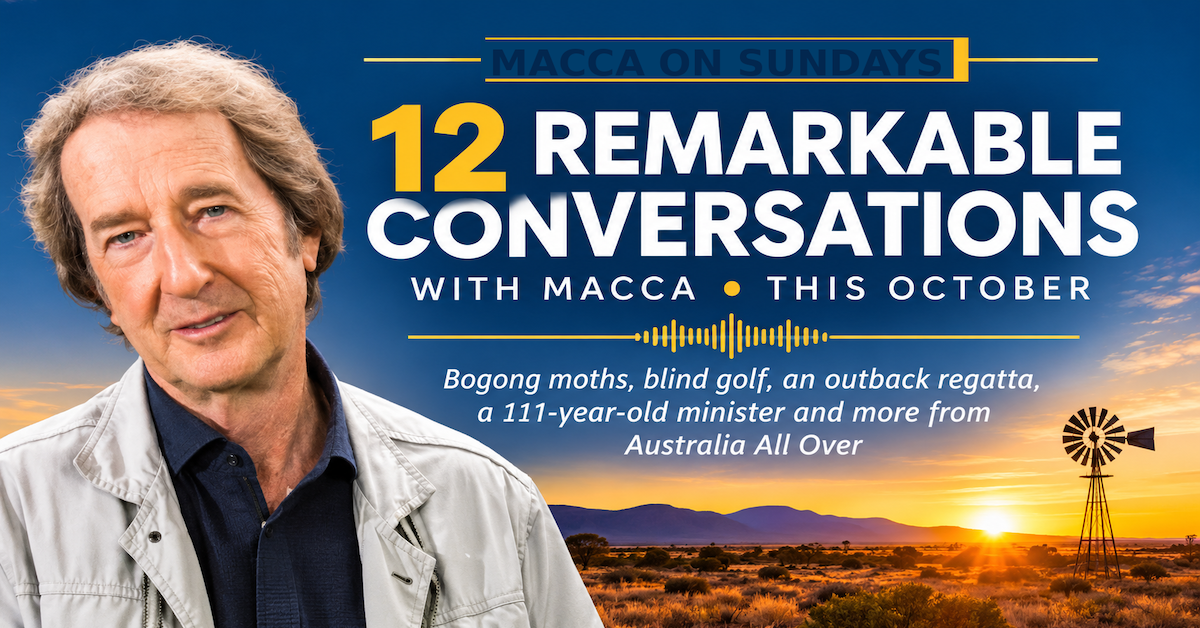
You never quite know where a Sunday morning with Ian ‘Macca’ McNamara will take you. One minute he’s discussing the final voyage of Captain Cook with a caller in French Polynesia; the next, he’s hearing about a macadamia farmer whose orchard has been visited by millions of moths.
Across the broadcasts of 4 and 25 October, the conversations ranged from the unusual to the quietly personal. There were adventures, strong opinions, a few unexpected discoveries and plenty of good humour.
Here are 12 that caught our attention.

Did Captain Cook change? Keiran Kelly has a Theory
From Moorea in French Polynesia, Kieran Kelly had a question about Captain James Cook that had occupied him for years: what happened to the celebrated navigator during his final Pacific voyage?
Kieran had grown up learning about Cook’s accomplishments, particularly his navigational skill and his reputation for dealing carefully with Pacific communities. But accounts of the third voyage presented a more troubling picture.
On Moorea, where Kieran was staying, an incident involving two stolen goats had led Cook to threaten local villages and canoes. Kieran was particularly struck by the threatened destruction of canoes, which were central to Polynesian life, serving as transport, fishing vessels and important expressions of social standing.
He had travelled to several islands associated with incidents from the voyage, trying to understand what he regarded as a deterioration in Cook’s judgement and temperament. Macca gave him room to work through his interpretation, including Kieran’s speculation about the circumstances of Cook’s death in Hawaii. His theory remains a personal reading of historical events rather than an established explanation.
Kieran’s travels and his book, They’re Not Really Like Us: My American Journey, led them into a discussion of contemporary politics and the pressures facing ordinary families.
“I call it the politics of despair,” Kieran said, suggesting that disillusioned voters were increasingly turning against political institutions rather than enthusiastically supporting particular leaders.
By the time Macca asked for the customary weather report, Moorea sounded like a different world altogether. Kieran described green jungle, brilliant blue water and a temperature of around 35 degrees.
A Golf Ball that Stays Still: Michelle’s Sporting Advantage
“The thing about golf is that the ball is stationary.”
Michelle had found a rather practical reason for choosing her sport. Compared with tennis, where the ball keeps moving, golf at least gives a player time to line up a shot. That matters considerably when you have only about ten per cent vision in both eyes.
Michelle was in Young, NSW, preparing for an interstate blind golf challenge between New South Wales and Victoria. She and other players had travelled down from Sydney, with a practice round ahead of the competition.
Each golfer had a caddie to help locate the ball, judge direction and position the player for the next shot. Michelle’s caddie was a friend who had travelled to join her. Macca wanted to know how the arrangement worked in practice.
The caddie could help Michelle aim, she explained, but after that, the shot was still up to the golfer. Asked about her chances of hitting the intended target, she replied: “A bit like any golfer at the 50-50 chance.”
Michelle had lost most of her sight about ten years earlier following a change affecting her optic nerves. Other competitors had experienced vision loss through different causes, including illness and accidents.
Young was busy with visitors, the countryside was looking lovely and there was every chance the golfers would encounter some rain.
“We’re hardy souls,” Michelle assured Macca.
Millions of Bogong Moths, One Extraordinary Macadamia Harvest
Andrew remembers what happened when he kicked a small pile of dead leaves on his macadamia farm about 15 years ago. A hundred or so moths flew out.
There were millions of them across the property, he recalled, sheltering from the daylight wherever they could find cover. They had arrived during flowering, and Andrew, who had spent 35 years growing macadamias in the Nambucca Valley, was fascinated.
He believed the bogong moths were feeding on the flowers at night and possibly helping with pollination. What followed was the best crop he had ever grown.
“We got our best crop we’ve ever had before or since.”
The timing was remarkable, although it did not prove that the moths were responsible for the harvest.
Now the bogongs had returned. Andrew had been following the wind patterns, wondering whether conditions might again carry the migrating insects towards his farm. When they arrived, he was delighted.
Andrew explained that wild bee populations on which his orchard had previously relied had declined following the arrival of varroa mite. This season he had paid to bring in 40 managed beehives for pollination.
Macca was equally interested in the insects themselves, whose seasonal migration takes them towards the Australian Alps. They talked about the moths’ habits, ecological importance and long association with Indigenous cultural traditions.
Whether another record harvest would follow was anybody’s guess.
Tracy’s Daughter Danielle and the Value of Getting on with the Job
Not every proud parent gets to tell the whole country about their child’s work. Tracy, calling from Beaudesert, had an opportunity to do just that.
Her daughter Danielle, 36, lived in Lethbridge Park in western Sydney and was involved in programming work associated with the baggage-handling systems at Western Sydney International Airport.
Danielle started in a bread shop before moving into warehousing, where she worked with computer systems used to manage orders. Tracy explained that her daughter was subsequently approached by a company involved in baggage-handling equipment, leading to the technical work she was now doing at the airport. Her responsibilities included programming systems and teaching other people how to use them.
What struck Tracy most was the enthusiasm she saw in her daughter and her colleagues. They were excited about the airport project and determined to get their part of it working properly. Even conversations with friends from work seemed to return to the job.
“I think the work ethic isn’t lost,” she said.
Towards the end of the call, Macca asked her daughter’s name. “Danielle,” Tracy answered. He offered his congratulations, much to the delight of a mother who had been waiting for the chance to tell someone about her.
Thirty Boats, Sixty Sailers and a Regatta in the Outback
Imagine towing a sailing boat thousands of kilometres into the Australian interior, only to have a day’s racing cancelled because it was too windy.
David had just returned from doing something very much like that.
The Lake Eyre Yacht Club’s eighth regatta had brought approximately 30 boats and 60 people to Lake Killamperpunna, near Cooper Creek in South Australia. Participants came from across the country, including Rockhampton and Western Australia, while David travelled with Peter and Pablo from the NSW Central Coast.
He was on the return journey along the Stuart Highway when he spoke to Macca. The obvious question was whether they had been sailing on Lake Eyre itself.
No, David explained. The event took place on Lake Killamperpunna, on the Cooper Creek system, where water conditions had made the regatta possible.
There had been competitive fleet racing, some lively conditions and one day when winds reached around 30 knots, forcing the organisers to abandon racing.
David also described the Rear Admiral’s Mug, a less conventional contest involving both running and sailing, associated with the club’s rear admiral, Dick Smith. He thought Tim from Melbourne had taken home the mug.
Macca was intrigued by the practicalities of sailing in such remote country. Large inland waters can develop substantial waves when strong winds arrive, and the distance from ordinary services adds another layer of difficulty.
The yacht club was based at Marree, with sailors travelling further into the outback to reach the water. For David, the journey had involved around 4,000 kilometres of travel. He sounded ready to do it again.
Reverend Bill Morgan Turns 111 — And Chris Has Something to Say About It
Reverend Bill Morgan had just turned 111, and Chris thought Macca’s listeners ought to know.
She had attended a birthday afternoon tea celebrating the Melbourne minister, who, she said, was still conducting religious services in the care facility where he lived.
Chris spoke warmly about his lifetime of service, describing someone who had devoted himself to faith, kindness and helping others.
Macca marvelled at the age. A man born in 1915 had lived through changes that most people could scarcely imagine, yet remained involved in the activity that had shaped much of his life.
Chris had recently travelled through Europe and Asia and noticed differences in how older people were treated. In Thailand, where her husband was using a walking stick after injuring his leg, she remembered being offered assistance and consideration without having to ask.
Back home, she felt that such courtesy was becoming less common.
They began comparing experiences with automated telephone services, businesses that were difficult to contact and the steady disappearance of paper-based alternatives. Chris had experienced the irritation of making repeated telephone calls simply to reach someone who could help her.
They also talked about the tone of public debate, the responsibilities of the media and the need for people to show greater consideration towards one another.
George Has the Barley. Now He Needs the Weather
After three poor seasons, George finally had the sort of barley crop that farmers dream about. Unfortunately, rain was getting in the way of harvesting it.
George was speaking from Waikerie in South Australia, where he worked as both a farmer and truck driver. He had seen plenty of seasons come and go, but this one was shaping up to be exceptional.
“This year they’re once in a lifetime, if we can get them off,” he told Macca.
A crop can look magnificent in the paddock, but until the grain is harvested and safely stored, there is still plenty that can go wrong. George had been waiting for suitable conditions, watching the weather and thinking about the work ahead.
He was also considering what would happen once the grain was ready to move. Storage capacity, freight and shipping arrangements all matter when large quantities of grain come onto the market.
George raised concerns about international grain movements, including reports he had heard about ships waiting for Ukrainian grain. These were his own observations rather than independently verified shipping information.
For the moment, though, his most immediate concern was much closer to home. After several disappointing years, the barley was finally looking good. He needed a break in the weather to get the harvest finished.
A Photographer, An Old Arcade and the Art of Seeing Differently
The sunlight was coming through the glass roof of Adelaide Arcade when Macca noticed a visitor taking photographs.
Michael, from Tucson in Arizona, had just photographed him in black and white.
Why black and white, Macca wondered, when modern cameras offered such extraordinary colour?
Michael explained that removing colour could reveal something that might otherwise be lost. In the photograph he had taken, he believed the absence of colour made the person more important than the surroundings.
“We don’t see you. We see the colour,” he explained.
The American visitor had spent 39 years working in historic preservation in Tucson, restoring older buildings and helping revitalise the city’s downtown area.
Retirement had given him time to travel, and he was making the most of it. More than 20 countries in two years had taken him through an extraordinary range of places, but he remained especially interested in old buildings and the stories they carried.
Adelaide suited him. Its historic architecture, arcades and streetscapes offered plenty to explore, particularly for someone accustomed to looking beyond the obvious tourist attractions.
Macca and Michael talked about the preservation of old buildings, the changing character of cities and the importance of retaining places that connect people with their history.
Jacob’s Father was Right About Moree After All
Jacob had never been much of a believer in the benefits of thermal springs. His father thought highly of them, but Jacob wasn’t convinced.
Then an accident during his travels left him unexpectedly in Moree, where he decided to try the town’s thermal pools. He went several times a day, spending time soaking in the warm mineral water.
For years, Jacob had experienced pain from plantar fasciitis, a condition affecting the tissue beneath the foot. After about three days of visiting the pools, he said, the pain disappeared. More remarkably, he told Macca it had not returned in approximately ten years.
The experience was personal rather than medical evidence that thermal bathing treats or cures the condition, but it had certainly made an impression on Jacob.
“I had to accept that dad was right on this one,” he admitted.
Jacob, a permanent firefighter working on Sydney’s North Shore, was just arriving for duty when he called. Their conversation also touched on the coming fire season, the wet conditions across parts of the country and the difficulties of predicting what might happen if the weather turned dry.
But Macca kept returning to the thermal pools. He was sufficiently intrigued to suggest he might have to try them himself.
At Fogg Damn, The Birds Were Already Putting On a Show
There was a nesting freshwater crocodile at Fogg Dam, and Jan wanted visitors to know it was best left alone. She also wanted them to know that the birds were looking magnificent.
Jan had called from Darwin to invite listeners to a twentieth-anniversary celebration for Friends of Fogg Dam, the volunteer organisation that helps care for the Northern Territory conservation reserve.
The group had arranged a morning gathering and displays explaining its work. For anyone within driving distance of Darwin, Jan thought it would be a lovely excuse to visit.
Macca was interested in the wildlife. Were there snakes? Hadn’t he once spoken to snake researcher Rick Shine about the area?
Jan described pythons and tree snakes, wallabies, freshwater crocodiles and buffalo visible on the distant plains. She was equally enthusiastic about the birds, particularly the magpie geese visiting the wetlands.
The Friends group held monthly working bees, with volunteers trimming vegetation, cleaning and helping keep walkways safe for visitors.
Jan recalled water remaining across the causeway for months during the previous wet, when birdlife gathered in extraordinary numbers. She invited Macca to return towards the end of the wet season, around March, when the group could show him the reserve at its most spectacular.
Macca admitted that despite visiting Darwin many times over the years, he had never experienced the Top End in the full wet season. Jan even promised to send photographs to help persuade him.
Sandra’s Lessons from the Hay Plains
Sandra had two good reasons to be pleased.
After a long dry spell, conditions had improved on the family property near Booligal, and they had recently cut around a thousand bales of hay. That was welcome news after roughly 18 months of drought.
But Sandra was equally enthusiastic about the Hay Inc Rural Education Program, which helps young people gain practical agricultural experience.
The program brings together participants aged 18 to 25 and experienced rural workers who share their knowledge through hands-on training.
It isn’t a conventional classroom arrangement. Participants learn about farming and rural work from people who have spent years dealing with livestock, machinery, changing seasons and the countless decisions that make up everyday agricultural life.
Sandra estimated that the trainers collectively represented hundreds of years of experience.
“It’s those skills that you need to learn,” Sandra explained, adding that some could only really be learned on the job.
She described a program that brought young people together for several training blocks, allowing them to develop skills, meet others in the industry and benefit from experienced mentors.
Some participants had grown up around agriculture. Others were looking for a way into rural work without the same family background or connections.
Troy’s Fifty-Year-Old Catamaran Still Has Plenty of Adventures Left
Troy doesn’t need a large yacht to enjoy Moreton Bay.
His boat is a 14-foot Caper Cat, around half a century old, which he calls Casper Caper. He sails it around the southern reaches of the bay, where even a relatively short outing can bring him close to some remarkable marine life.
Dugongs, loggerhead turtles, sharks and whales have all featured in his sailing experiences.
Macca was keen to hear about the encounters, and Troy was equally happy to describe them. There was obvious affection in the way he spoke about the boat and the waters he knew so well.
Their conversation wasn’t confined to sailing, however. The Redcliffe Dolphins entered the discussion, followed by music, and before long they were talking about Willie Nelson and Neil Young.
Macca and Troy found common ground in Young’s interest in cars, including the old hearse associated with his early musical travels and the beginnings of Buffalo Springfield.
The discussion eventually reached Long May You Run, Young’s song about a much-loved vehicle.
And somewhere in southern Moreton Bay, Casper Caper was still giving Troy good reason to get out on the water.
The Pleasure of Not Knowing Who Will Call Next
The two October broadcasts covered an extraordinary amount of ground, from Moorea and the Australian interior to the wetlands outside Darwin and the waters of Moreton Bay.
There were stories of remarkable longevity, changing careers, farming challenges and unusual adventures. There were also questions that remained unanswered, such as whether Andrew’s bogong moths would be followed by another exceptional macadamia harvest.
Sometimes the most memorable part was a small detail: Michelle’s wonderfully practical explanation of blind golf, Jacob admitting his father had been right, or Tracy taking the opportunity to tell Australia how proud she was of Danielle.
They’re the sorts of moments that rarely make headlines but are worth hearing all the same.
And that’s part of the enduring appeal of Australia All Over. On any given Sunday, nobody quite knows where the next conversation will lead — least of all Macca.
Listen to the podcast episode here.
Disclaimer: ‘Australia All Over’ is a program produced and broadcast by the ABC Local Radio Network and hosted by Ian McNamara. Brisbane Suburbs Online News has no affiliation with Ian McNamara, the ABC, or the ‘Australia All Over’ program. This weekly review is an independent summary based on publicly available episodes. All original content and recordings remain the property of the ABC. Our summaries are written in our own words and are intended for commentary and review purposes only. Readers can listen to the full episodes via the official ABC platforms.