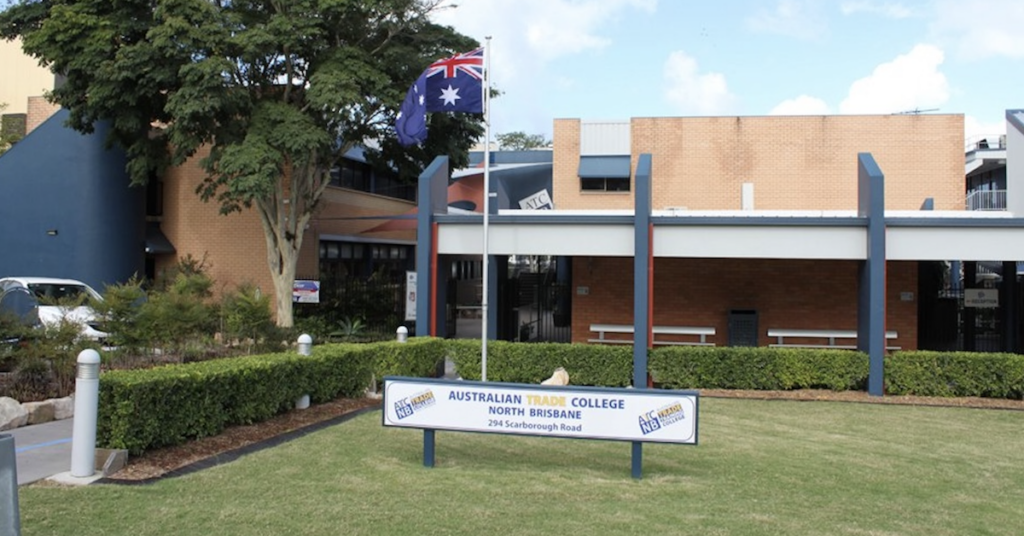
A graduate of the Scarborough-based Australian Trade College North Brisbane has shifted her career direction after discovering a passion for teaching while volunteering in rural Cambodia, showing how a trade pathway can lead to unexpected opportunities beyond the salon.
Georgia Creevey joined an eight-day volunteer placement in Cambodian village schools through the yLead Alternative Schoolies program in November. The experience formed part of the college’s leadership and service partnership with the youth organisation.
From Hairdressing Apprentice to Aspiring Teacher
Creevey completed her hairdressing training at the Scarborough campus and received the college’s Year 12 Commendation Award for Hairdressing. While she had been preparing for a career in the salon industry, the volunteer program introduced her to a different kind of work.
During the placement, she spent time helping primary school students practise English and interacting with children eager to learn about life outside their village. The experience revealed that many of the communication skills developed during her apprenticeship could apply in a classroom setting.
The people skills required in hairdressing — listening closely to clients, understanding their needs and helping them feel comfortable — translated well into supporting young learners who were navigating language barriers.
Program leaders with yLead encouraged Creevey to consider teaching as a future career after observing how she connected with students during classroom activities and group discussions.
A Program Linking Scarborough Students to Global Experiences
The volunteer placement was part of the Alternative Schoolies initiative run by yLead, which offers young Australians the chance to take part in service-focused travel instead of traditional end-of-school celebrations.
Each year, students connected to the Australian Trade College North Brisbane take part in these programs in destinations, including Cambodia, New Zealand, Kokoda and Tanzania.
The college says the partnership aims to give trade students leadership and community engagement opportunities alongside their vocational training. According to ATCNB acting principal Megan Moore, these experiences help students build perspective, maturity and confidence that can carry into different industries.
Creevey travelled to Cambodia with fellow graduates Jorja Butler and Emily McLucas. Butler had earlier received the Year 12 Excellence Award for Hairdressing and progressed quickly through her apprenticeship, while McLucas served as a student ambassador during her time at the college.
After the Cambodia Experience
After returning to Australia, Creevey decided to pursue teaching. She has enrolled in a bridging course at the University of the Sunshine Coast and plans to begin a Bachelor of Primary Education in mid-2026.
She has also been selected as a mentor for yLead in 2026, where she will support students attending leadership conferences and may return to Cambodia with a future program group.
The college said Creevey’s story reflects how vocational education can provide pathways that extend beyond the original trade, with real-world experiences helping students recognise new strengths and interests.
Residents in Newport are calling for improved bus services, saying better connections are needed to link the growing suburb with nearby shops, the waterfront and Kippa-Ring train station.
The discussion has gained attention in recent months through a community petition calling for expanded bus services in Newport. The petition asks for routes that better connect residents to key destinations across the Redcliffe Peninsula, including Kippa-Ring station, local shopping areas and the foreshore.
Current Transport Services in Newport
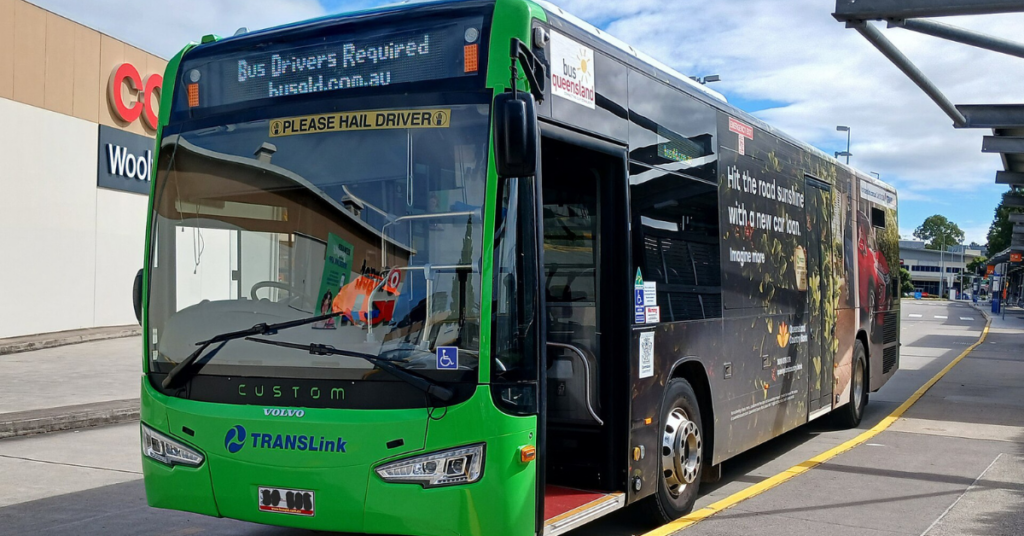
Newport is already served by public transport through the Translink network. One of the primary routes operating in the area is Route 699, which services several stops including Newport Drive, Griffith Road and Endeavour Esplanade.
According to Translink timetables, Route 699 travels through the peninsula and connects with Kippa-Ring station, providing access to the Redcliffe Peninsula Line for travel towards Brisbane.
The route means Newport residents do have access to public transport, although some locals say the current service does not fully meet the needs of a growing residential area.
Newport has seen steady residential growth in recent years, with new housing developments bringing more families and commuters to the suburb.
For residents without regular access to a car, buses play an important role in connecting the community to daily destinations such as schools, workplaces, shopping centres and medical services.
Public transport can also provide easier access to the train network at Kippa-Ring, which many peninsula commuters rely on for travel into Brisbane.
Community Advocacy Gaining Attention
The call for improved services has also drawn interest from the South-East Queensland Transport Association (SEQTA), a community advocacy group focused on public transport issues across the region.
SEQTA describes itself as an independent community organisation advocating for improvements in public transport frequency, accessibility and network coverage across South-East Queensland.
Earlier this year, members of the group met with Redcliffe MP Kerri-Anne Dooley, who later shared on social media that the discussion included public transport improvements on the peninsula and encouraged residents to sign the Newport bus petition.
The Newport discussion comes as transport planning continues across South-East Queensland in the lead-up to the 2032 Olympic and Paralympic Games. Leaders are currently exploring several potential expansions to the Brisbane Metro network.
But the key question remains whether the current bus network will evolve alongside Newport’s growth. Advocates say improving local bus connections would make it easier for residents to travel around the peninsula without relying entirely on cars.
More than 30,000 responses have been collected since 2021, and residents are again being invited to take part in the next Moreton Says. The community survey invites locals across Moreton Bay to speak up on liveability, jobs and disaster preparednes.
The City of Moreton Bay has opened its latest Moreton Says survey, calling on locals to share their views before it closes at 4:00 p.m. on 29 March 2026. The survey, which runs twice a year, asks residents about liveability and lifestyle, local jobs and business support, disaster preparedness, sport and recreation, and their experiences with council services.
How the survey is used
Council says the survey data feeds into its planning, policy work and day-to-day decisions, helping it keep track of what matters to residents as the city grows and changes.
The initiative has collected more than 30,000 responses to date, which Council describes as one of the most consistent and comprehensive community insights programs in Queensland local government.
The broader program information and past results are outlined on the Moreton Says community engagement page.
Disaster preparedness remains a key topic
Earlier survey feedback suggested many residents were willing to prepare for severe weather, but were not always sure how. Council says this feedback has been used to refine how it communicates hazard risks and household preparedness tools, with a focus on clearer guidance and simpler resources.
Council also reports that more than 30 per cent of previous respondents accessed information about natural hazard risk before moving to the City of Moreton Bay, reinforcing the need for practical and easy-to-find preparedness information.
How to take part
Residents can have their say by completing the survey online, taking part at a Moreton Says pop-up, requesting a hard copy via yoursay@moretonbay.qld.gov.au, or filling out a paper survey at a council library or customer service centre.
People who complete the survey can enter the draw to win one of twenty $100 Moreton Money gift cards, which can be redeemed at more than 260 local businesses. Competition details are available through the Moreton Says page.
Council says the survey helps inform its decisions and track what matters to residents as the city changes.
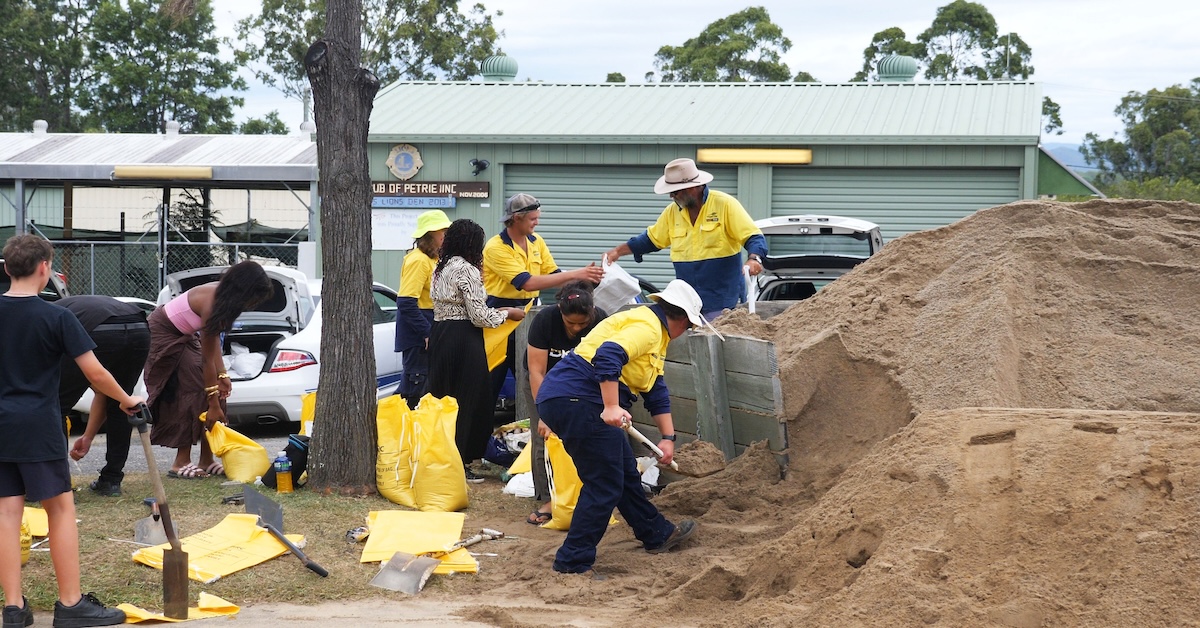
Communities across Moreton Bay are on alert as crews deploy emergency sandbag stations ahead of severe weather expected to affect the region. The move aims to help residents reduce the risk of floodwater entering their properties, as authorities warn heavy rain and storms could cause flash flooding and rising waterways across vulnerable suburbs.
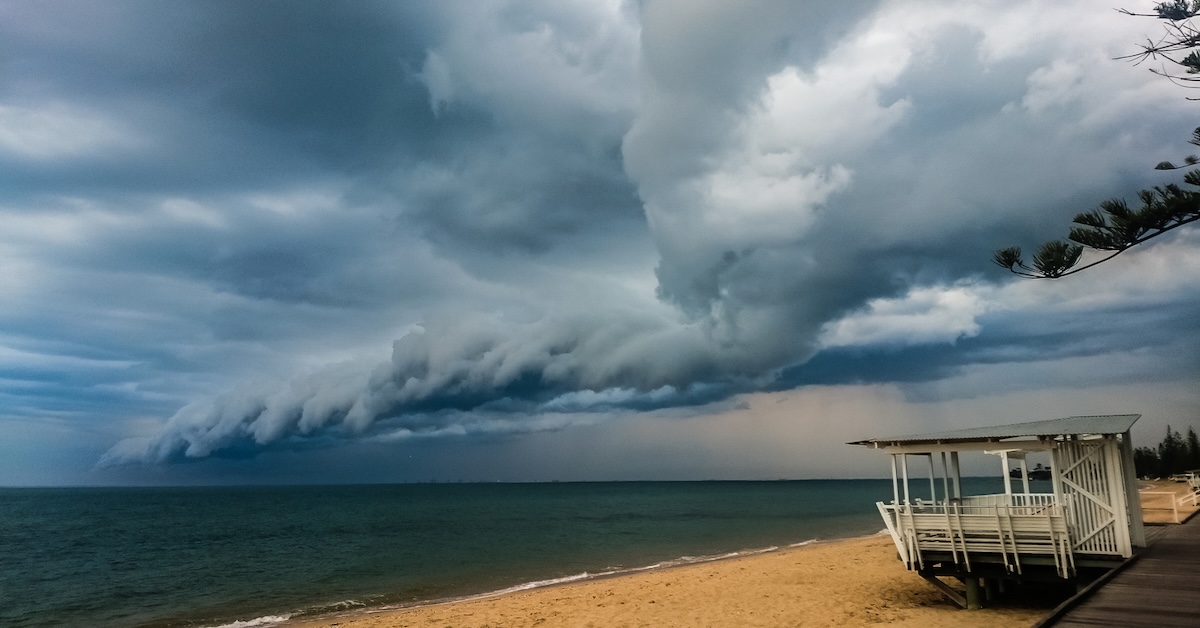
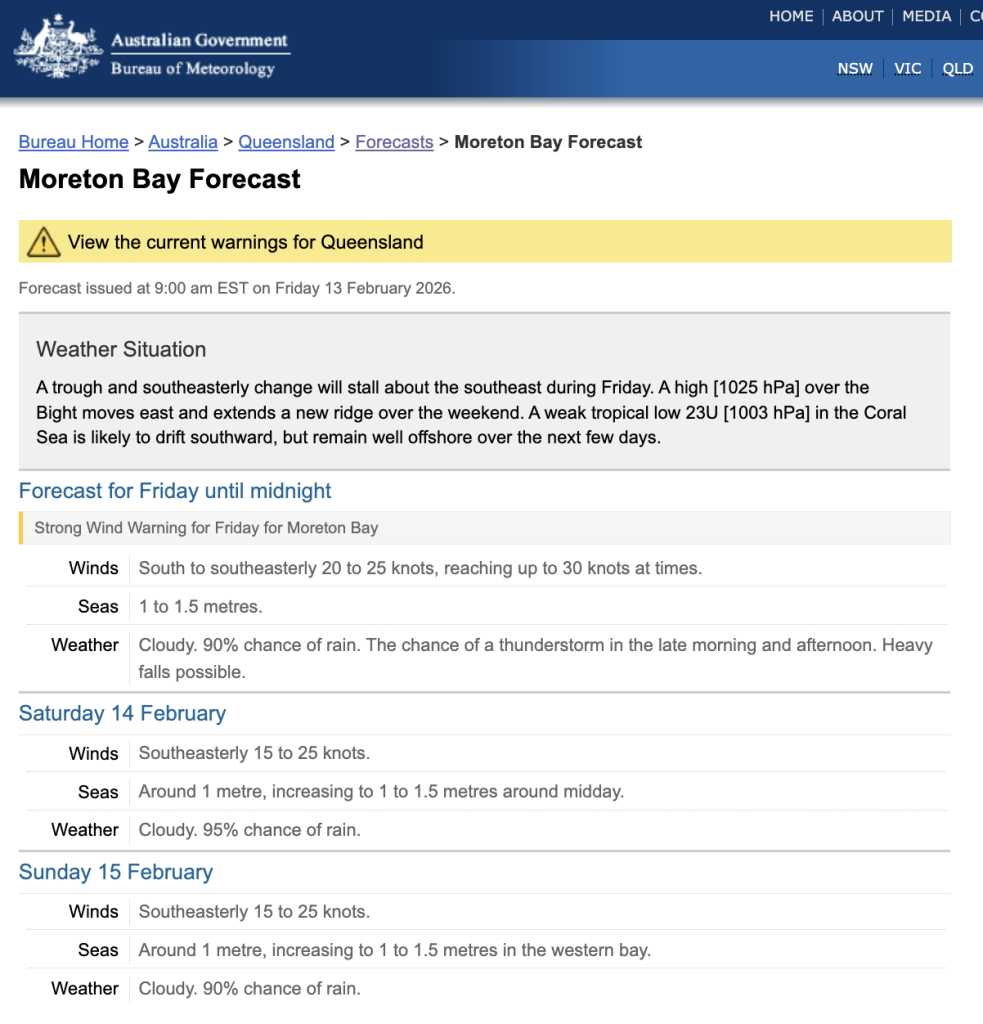
Severe weather warnings and flood watches have been issued for parts of South East Queensland, with the Bureau of Meteorology warning heavy rainfall could impact catchments, including local creeks and rivers, in the coming days. The agency also warns of minor to moderate flooding from Friday and through the weekend, with rapid river rises and isolated major flooding possible where the heaviest rain falls.
Photo Credit: Bureau of Meteorology
‘If it’s flooded, forget it’
From Friday afternoon, 13 February, Mayor Peter Flannery urged households to take simple steps that can make a big difference if storms hit hard: clear gutters, clean up yards, pack an emergency kit, check insurance and prepare a household emergency plan. He also encouraged residents to download a flood check property report to better understand their local risk.
His main message was short and direct: “If it’s flooded, forget it.” The warning comes as crews monitor low-lying areas and roads that can become dangerous quickly during intense downpours.
Sandbags: where to go and what to bring
The City of Moreton Bay confirmed sandbag stations are now operating at multiple locations.
Arana Hills SES — 2 Pine Hills Drive (off Jinker Track)
Beachmere — Rogers Street Sports Ground
Bribie Island SES — 208–224 First Ave.
Caboolture Council Depot — corner of Commercial Drive and Machinery Parade
**Deception Bay Council De Bay Road
Elimbah — Coronation Drive (opposite the church in the median strip)
Narangba — Oakey Flat Road (between the Raynbird Road and Sovereign Drive roundabouts)
Petrie SES — 3 Woonara Drive
Woodford Depot — 20 Durundur St., Woodford
Woodford Memorial Hall (rear car park) — 103 Archer St.
Dayboro Depot — 73 Bradley St.
Margate Depot — Jull St.
Toorbul and Donnybrook Seniors Club — 1798 Pumicestone Road
Residents can check live updates through the City of Moreton Bay Disaster Dashboard, which also provides road closure updates and weather alerts.
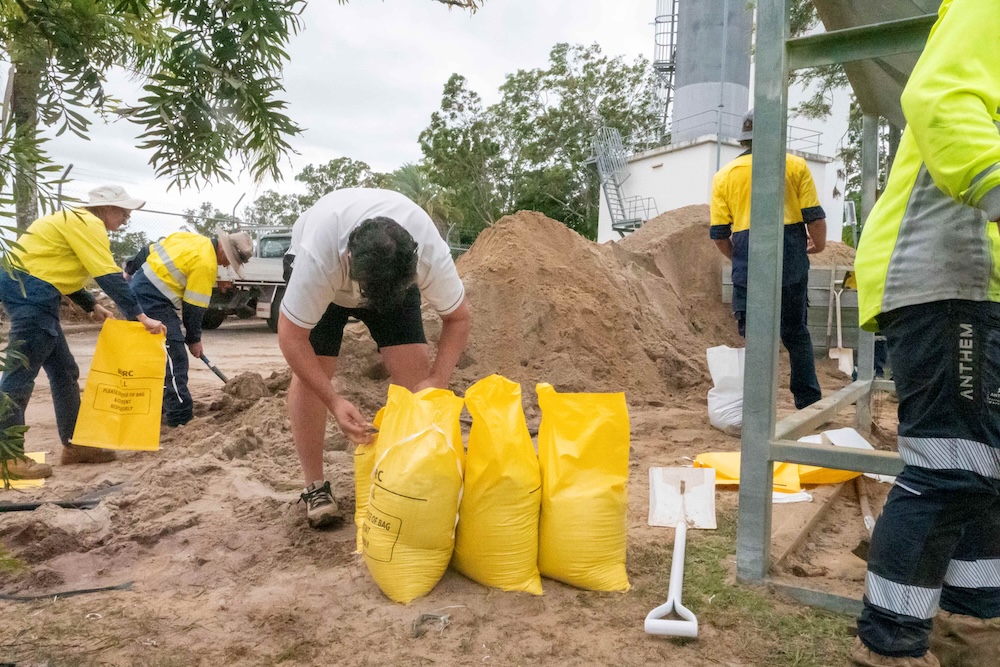
Council officials are reminding residents that while sandbags can help limit water entering homes, they do not completely stop flooding. People attending collection points are asked to bring their own shovels, as bags must be filled on-site.
Photo Credit: Supplied
Authorities are also encouraging residents to sign up for MoretonAlert, a free warning system that sends SMS, phone and email alerts based on a resident’s local address. The service is designed to give early notice about severe weather, flooding risks and emergency situations.
For residents who cannot collect sandbags themselves due to age, illness or physical limitations, assistance may be available through the State Emergency Service by calling 132 500.
SES on standby
Council said its roads and drainage teams, along with the SES, are on standby. The council’s Local Disaster Management Group has also been put on alert as the weather system develops. Residents can track road closures and official updates on the City of Moreton Bay Disaster Dashboard.
In addition to sandbag distribution, council-operated places of refuge have opened at several library locations across the region. These locations provide safe shelter options if conditions worsen.
Burpengary Library — 121 Station Road, Burpengary
Deception Bay Library — 9 Bayview Terrace
Redcliffe Library — 476 Oxley Ave.
Albany Creek Library — 16 Ferguson St.
Bribie Island Library — 1 Welsby Parade, Bongaree
Arana Hills Library — 63 Cobbity Cres.
Woodford Library — 1 Elizabeth St.
Caboolture Hub Library — 4 Hasking St.
North Lakes Library — 10 The Corso
Emergency services are urging residents to stay informed, monitor weather warnings and prepare emergency plans, particularly those living in flood-prone areas or near waterways. Residents can also track official warnings through the Bureau of Meteorology website for updated forecasts and storm alerts.
Next time you turn onto Valiant Court or launch your tinny into Pelican Canal, take a moment to consider the stories beneath those familiar names. Unlike many suburbs where street names arrive via bureaucratic decree, Newport’s identity was deliberately crafted — part community choice, part homage to sailing history. The result is a neighbourhood where every signpost tells a story about who we are and what we value.
In 1987, Newport residents faced a question: what should define our waterways? The answer came through a community poll conducted by the Newport Waterways Property Owners Association (NWPOA), and it wasn’t left to bureaucrats or developers. The neighbours chose Australian coastal and seabirds, a decision that shaped every canal development since and embedded our natural environment into the suburb’s DNA.
Street Names: Newport, Rhode Island to Newport, Queensland
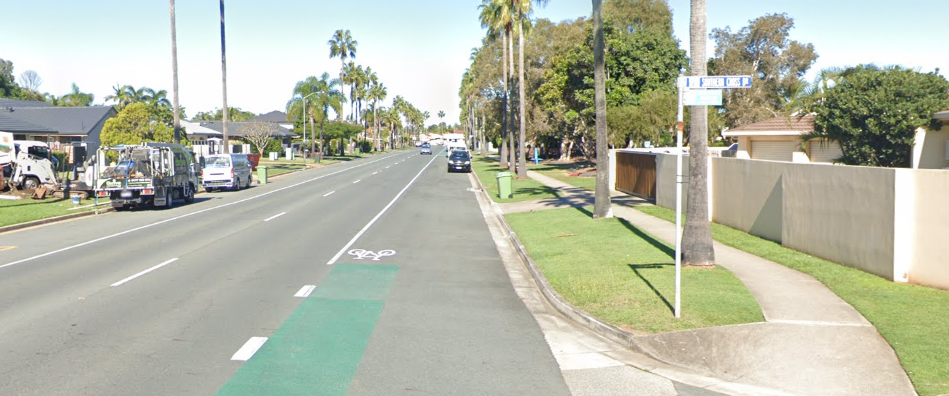
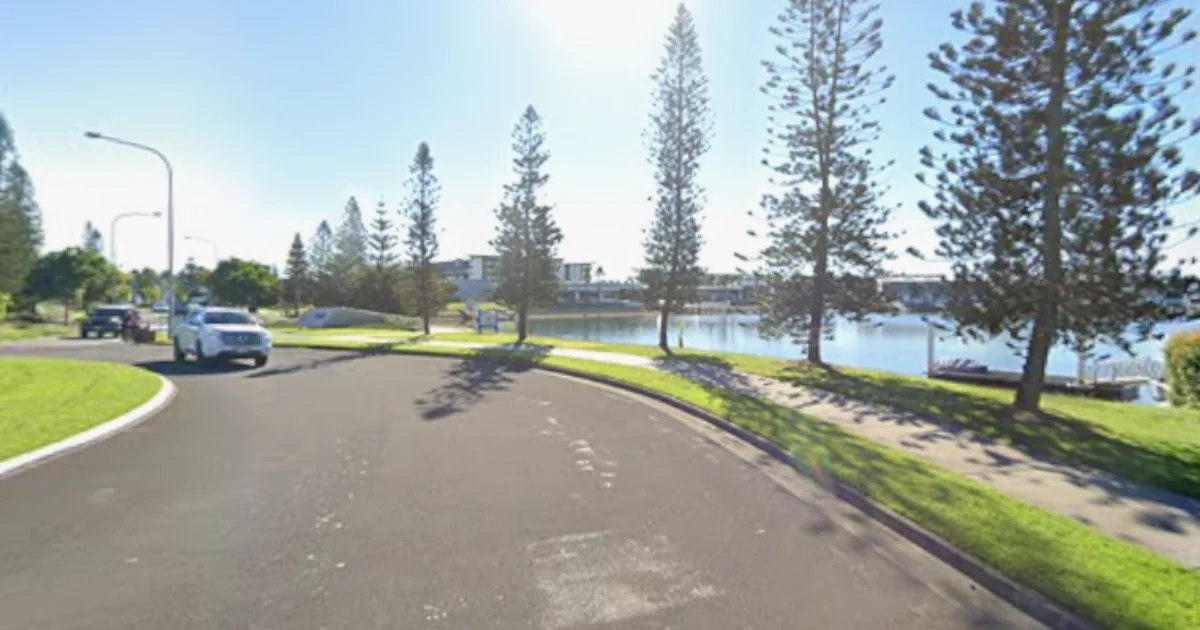
Southern Cross Drive, Newport (Photo credit: Google Street View)
While the canals celebrate Australian birdlife, our streets pay tribute to an altogether different maritime tradition: the America’s Cup. Specifically, they honour the legendary yachts that competed off Newport, Rhode Island, between 1930 and 1983, an era when 12-metre yachts represented the pinnacle of sailing technology and national prestige.
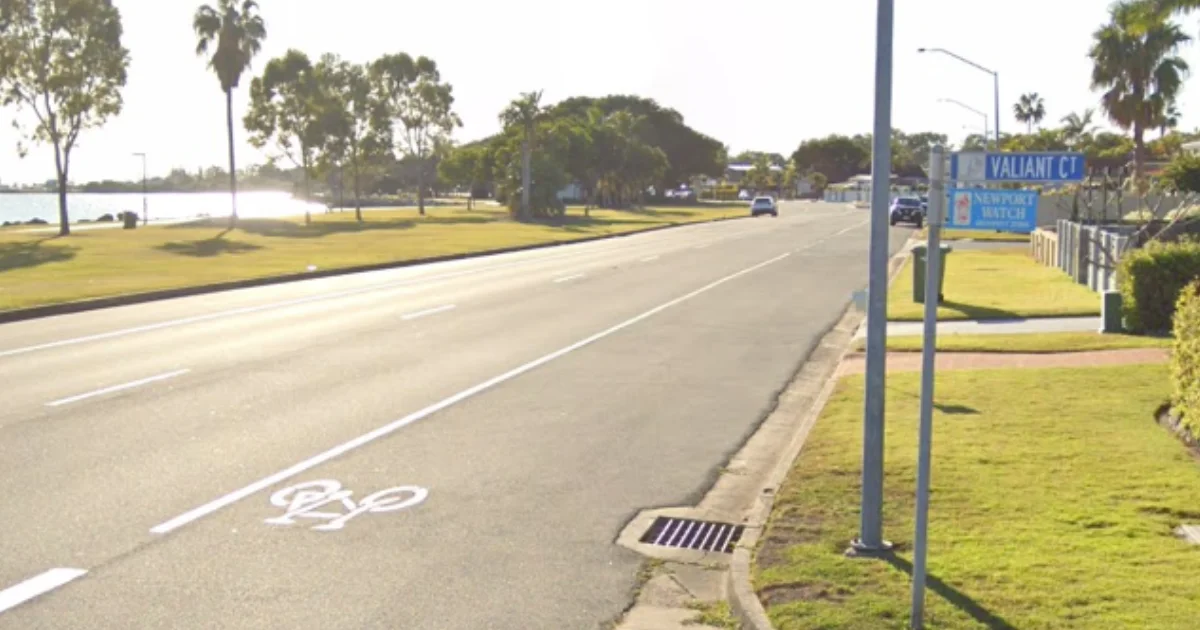
Valiant Court takes its name from Valiant (US-24), an American challenger that competed in the 1970 and 1974 America’s Cup campaigns. Contemporary reports described Valiant struggling against formidable competitors like Courageous, with races decided by razor-thin margins of hull speed, tactical positioning and wind strategy. The New York Times described how Valiant ‘bombed out’ during trial races, yet the yacht’s competitive spirit earned it a permanent place in sailing lore and, eventually, on our street signs.
Closer to home, Southern Cross Drive honours Australia’s own America’s Cup challenger. Southern Cross (KA-4) took on Courageous in 1974, representing a distinctly Australian effort. Built in Terry Hills by Halvorsen Morson and Gowland of Mona Vale, and bankrolled by Perth entrepreneur Alan Bond, the yacht was designed by Ben Lexcen — then still known as Bob Miller — who would later design the winged-keel Australia II that finally broke the Americans’ 132-year stranglehold on the Cup in 1983.
Southern Cross boasted a towering 29.6-metre mast and made history as the first aluminium yacht to compete in the America’s Cup. The 1974 campaign began promisingly, with Southern Cross taking early leads. But a near-collision in the second race forced both crews to raise protest flags, and Courageous seized the opportunity to gain clear air and momentum. The final race became a tacking duel — each boat jockeying for position — with Courageous ultimately finishing one minute and 11 seconds ahead. In post-race interviews, the Southern Cross crew admitted their tactical error: failing to tack back when Courageous took the lead.
Canal Names: A Community-Chosen Identity
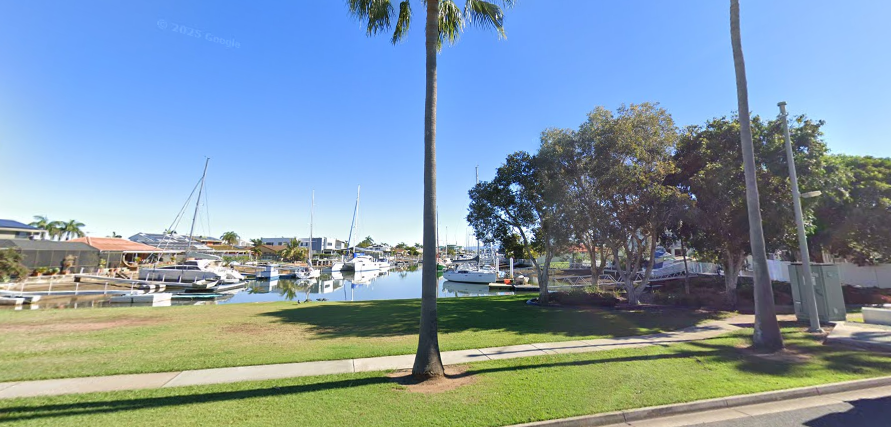
Photo credit: Google Street View
Newport’s canal names were never arbitrary. That 1987 NWPOA poll put the decision in residents’ hands, and we chose to honour the coastal and seabird species that define our region’s ecology. It’s a choice reflected across our waterways.
Pelican Canal runs approximately 650 metres from the marina to Newport Drive, forming the scenic backdrop to homes along Courageous Court, Griffith Road, France Court and Sverige Court. Jabiru Canal extends roughly 830 metres from Albatross Canal to the Spinnaker Boulevard roundabout, running behind Wildfire Court, Constance Court and Quay Circuit.
The Jabiru, Australia’s black-necked stork, deserves special mention as our largest wetland bird, reaching about 1.4 metres in height with a wingspan exceeding two metres. Although widespread, they typically occur at low population densities. This ecological detail is thoughtfully explained on the interpretive signage that Moreton Bay installed at each canal’s end.
The Council didn’t just accept the NWPOA’s naming tradition — they embraced it, installing seating and descriptive signage at each canal’s end. These small installations embed environmental storytelling into daily life, turning an ordinary walk or bike ride into an opportunity to learn about the birds that share our waterways.
This dual naming approach, seabirds on the water, legendary yachts on land, creates Newport’s distinctive identity. We’re a community shaped by both our natural coastal environment and our connection to international sailing culture. Every street sign and canal marker reinforces that story, reminding us that where we live isn’t just geography. It’s heritage, aspiration and a community decision made nearly four decades ago that continues to define us today.
Julie thought she knew what to expect when she moved near Newport Lake — inspections done, lifestyle understood, and a generally quiet bayside rhythm assumed.That sense of calm, she says, did not last.
“I’ve had my sleep broken almost nightly well after midnight and it is destroying my peace,” Julie wrote. “It’s invasive and unsettling, and it makes me feel vulnerable in my own home.”
Julie believes the sound carries from the Scarborough direction, particularly late at night. She says the disruption has left her anxious and unsettled, particularly as an older person living alone.
Her experience reflects what other residents near Thurecht Parade, Scarborough have reported over several years: that late-night hooning activity around the car park opposite the Coast Guard can be disruptive and difficult to prevent, particularly at night.
For many residents, it is not something they say they fully understood until after they had settled into the area.
A quality-of-life issue, not just antisocial behaviour
Hooning is often framed as a law-and-order issue. For residents living nearby, it is first and foremost a quality-of-life concern.
Noise late at night can carry further across open spaces and water. What might be intermittent elsewhere can feel amplified and prolonged in waterfront precincts. Residents describe disrupted sleep, anxiety around evenings and weekends, reluctance to use balconies or open windows at night, and concern for pedestrians, parked vehicles and nearby homes.
The issue is not just noise, but uncertainty — not knowing when activity will start, how long it will last, or whether it will escalate.
Reported incidents and police response
In late 2024, locals reported that hooning activity escalated over several nights near the Thurecht Parade car park, with large groups of vehicles gathering, tyre rubber left on the pavement, debris scattered through the area and damage to fencing reported in other media. Residents said activity intensified toward the end of the week, heightening concerns about public safety.
Police later confirmed they had received multiple reports of hooning at the site across consecutive evenings, including reports around 9pm on a Thursday and again shortly before 9pm on the Friday.
Initial reports described large groups of people gathered in the car park, with multiple vehicles allegedly being driven in a dangerous manner. Police attended the area in response, observed groups of vehicles present, and directed those vehicles to move on. The police helicopter was also tasked to observe the area from above.
Police subsequently stated that while vehicles were present during patrols and aerial observation, no offences were detected at the specific times officers were monitoring the site.
Residents say this pattern — gatherings forming, dispersing when police arrive, and later re-forming — has occurred repeatedly over time, contributing to a sense that enforcement alone has struggled to deter the behaviour at this location.
What this means for neighbourhood amenity and confidence
There is no single measure for how late-night hooning affects a community. But neighbourhood confidence is shaped by perception, predictability and experience.
Where disruption is widely known and consistently addressed, residents tend to feel reassured. Where it is intermittent, highly disruptive and perceived as unresolved, it can erode confidence and create tension within a community.
Research into environmental noise shows that persistent disturbance can influence how people feel about where they live. While most formal studies focus on road or aircraft noise rather than hooning specifically, the principle is similar: amenity matters, particularly in areas valued for lifestyle and calm.
Hooning also carries an added dimension — perceived safety risk. Noise alone is one thing. The fear of vehicles losing control near public spaces, homes or pedestrians is another. That perception weighs heavily on families, older residents and those drawn to waterfront living for its tranquillity.
Consequences: what Queensland authorities say — and what enforcement looks like locally
Queensland’s hooning laws have been progressively strengthened, with authorities repeatedly emphasising that dangerous driving is treated as a serious public safety risk.
In 2022, then Minister for Police and Corrective Services and Minister for Fire and Emergency Services Mark Ryan warned that legislative changes would allow courts to order the destruction of vehicles used in hooning offences.
“If you tear up the road, we’ll tear up your car — it’s that simple,” the minister said at the time, describing hooning as behaviour that “intentionally endanger[s] lives” and should attract severe consequences.
That stance continues to be reflected in day-to-day policing across South East Queensland.
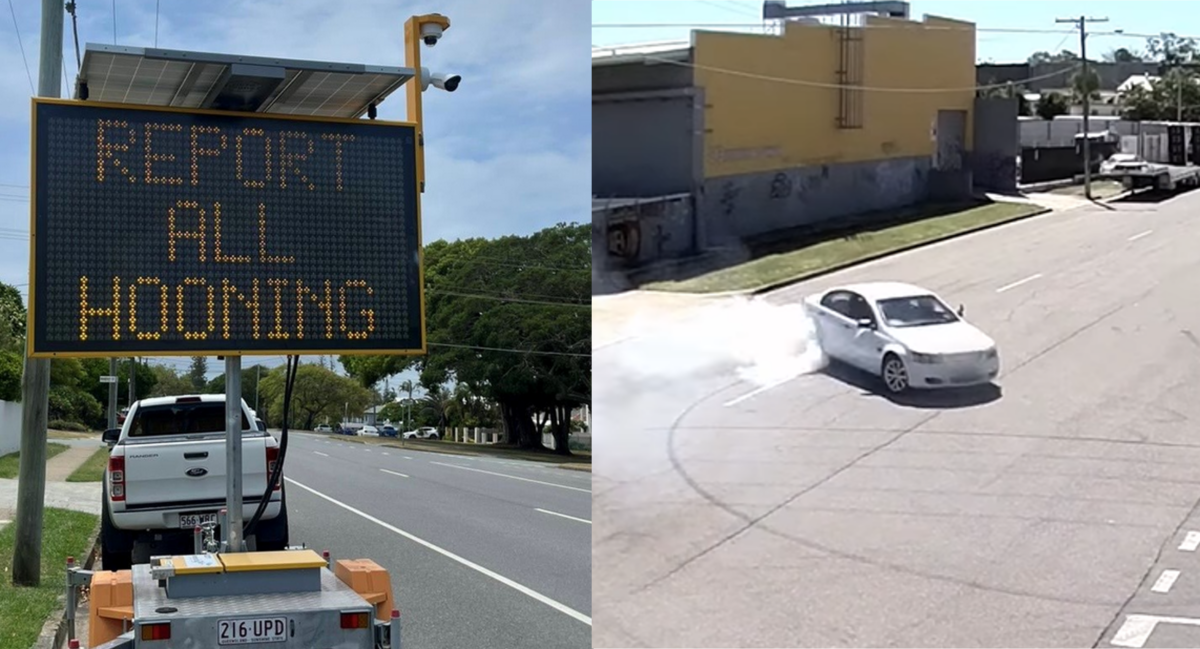
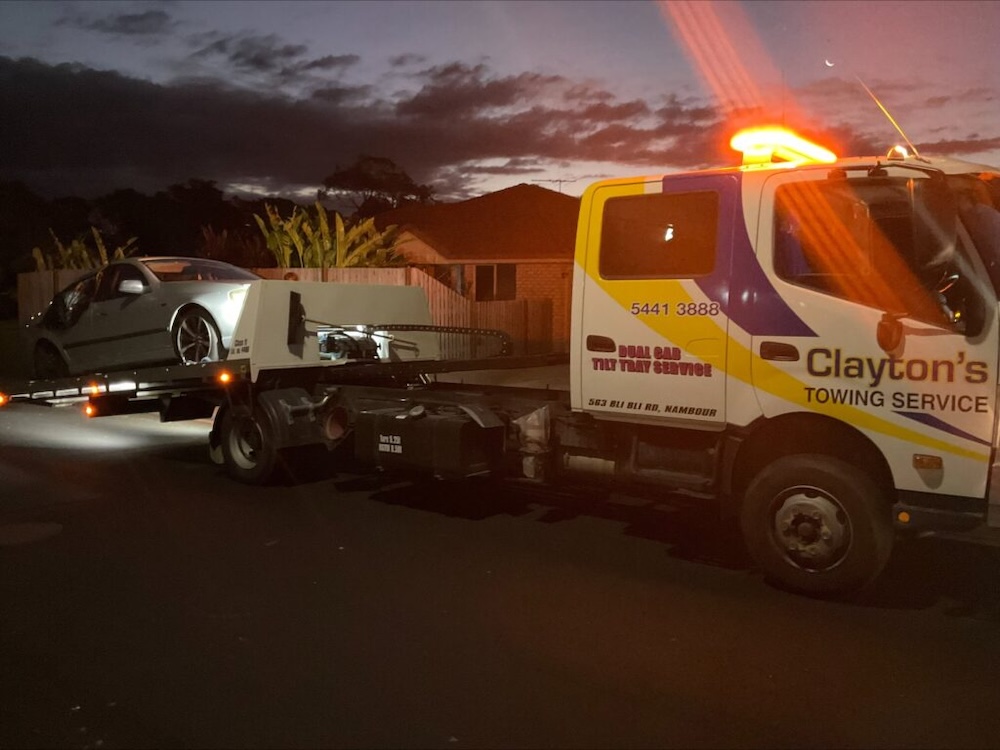
In June 2025, officers from Moreton South Highway Patrol charged an 18-year-old man following alleged hooning offences in Warner, north of Brisbane. Police allege the driver was observed doing a burnout on Gum Street and later hooning near a shopping complex on Samsonvale Road. The vehicle was seized, and the alleged offences resulted in a 90-day immobilisation. The man is due to appear before Pine Rivers Magistrates Court on July 24 (reference number QP2501134662).
Senior Sergeant Brett Stevenson said police would not tolerate hooning behaviour, warning that “intentionally driving in a dangerous manner on public roads puts lives at risk” and that offenders should expect consequences if caught.
The case illustrates the enforcement pathway residents are often urged to rely on — report, investigate, seize and prosecute — even as communities continue to push for preventative measures at known hotspots.
The promise of tranquillity — and the reality residents describe
Newport has been promoted around lifestyle, water and retreat. Promotional material consistently emphasises calm, escape from congestion and a relaxed bayside environment, with Newport Lake positioned as a central lifestyle feature.
Many residents say they experience exactly that during the day and much of the week.
However, where late-night hooning is reported to recur, a tension emerges between expectations of tranquillity and lived experience — particularly for residents closest to identified hotspots.
This is not an allegation of wrongdoing. It is a reflection of how even limited, late-night activity can have an outsized impact on amenity in otherwise quiet areas.
Who is responsible — and why solutions feel slow
Responsibility for addressing hooning is shared across multiple authorities.
Queensland Police are responsible for enforcing hooning and dangerous driving laws, but action depends on offences being observable at the time or supported by evidence.
Local government can support prevention through traffic management processes, public-safety infrastructure and coordination, but does not enforce driving offences.
If the land on which the Thurecht Parade car park sits is publicly owned, meaning physical changes such as barriers or speed-calming measures may require state involvement rather than local council action alone.
Residents and business owners say they have reported incidents, met with authorities and participated in community discussions, but feel progress has been slow and fragmented.
This isn’t just a local issue
Concerns about late-night racing and noise are not unique to Newport or Moreton Bay.
In other cities around the world, residents living near wide roads or open car parks have described similar patterns: vehicles gathering late at night, noise disrupting sleep, and drivers dispersing before enforcement arrives.
Some jurisdictions respond by combining strict enforcement on public roads with investment in legal motorsport venues, allowing high-performance driving to occur in controlled environments rather than residential streets.
While such approaches do not eliminate antisocial behaviour entirely, they illustrate how enforcement, infrastructure and planning are often used together rather than in isolation.
International examples: separating high-performance driving from public roads
Internationally, some jurisdictions have paired strict enforcement of dangerous driving laws with investment in regulated motorsport facilities, aimed at shifting high-performance driving away from public streets and into controlled environments.
In Dubai, this approach has included purpose-built venues such as Dubai Autodrome and the adjacent Dubai Kartdrome, alongside strong traffic enforcement and penalties for illegal street racing. Authorities and road-safety agencies have previously pointed to the role of dedicated facilities in reducing unsafe driving on public roads by providing legal, supervised alternatives for performance-oriented driving.
While such measures do not eliminate antisocial behaviour entirely, international examples are often cited by planners and transport authorities as part of a broader strategy — combining enforcement, infrastructure design and behavioural redirection — rather than relying on policing alone.
Could different design reduce the problem here?
International experience suggests hooning hotspots are difficult to address through enforcement alone.
More durable responses often involve physical design changes that make locations less attractive for gatherings, improved access to usable evidence, consistent and visible policing operations, and clear communication so residents understand what measures are being trialled.
In Scarborough and Newport, residents have repeatedly pointed to physical deterrence — changes to layout, access or surface design — as a necessary complement to policing.
A question residents and planners continue to grapple with
Julie’s story is not about blame. It is about expectations and liveability.
If a neighbourhood is valued for its calm and lifestyle, even intermittent late-night disruption can have a disproportionate impact on how people experience their homes.
The longer concerns persist without a visible, coordinated response, the harder it becomes for residents to feel confident the issue is being meaningfully addressed.
FAQ: hooning and liveability in Moreton Bay
Is hooning illegal in Queensland? Yes. Hooning and dangerous driving offences carry serious penalties, including vehicle impoundment, immobilisation and forfeiture for repeat offences.
Who should residents report hooning to? Hooning should be reported to Queensland Police via the dedicated Hooning Hotline on 13HOON (13 46 66) or through the online reporting form. Reports are most useful when they include the time, location, description of vehicles and behaviour, and any available vision.
Can council stop hooning? Council does not enforce driving offences, but may support prevention through infrastructure, traffic management processes and public-safety measures, depending on land ownership and jurisdiction.
Does hooning affect how people feel about where they live? Persistent noise and perceived safety risks can influence residents’ sense of comfort, security and enjoyment of their neighbourhood, particularly in areas known for quiet, lifestyle-focused living.
What can residents do if the issue continues? Document patterns, report incidents promptly, participate in community discussions, and engage with police and local authorities to support longer-term solutions.
Australia Day in Moreton Bay is rarely about one central stage. It’s marked locally — along the foreshore, at community venues, neighbourhood pools and familiar clubs — often just a short drive from home.
From live music by the water to family fun days, pool parties and an afternoon out on the bay, this guide brings together Australia Day events happening across the Moreton Bay region, arranged geographically so you can see what’s on near you.
This Australia Day cruise departs Redcliffe Jetty aboard Eye Spy, a purpose-built catamaran operated by Brisbane Whale Watching. The three-hour cruise runs across Moreton Bay, offering seated indoor and outdoor deck space and steady cruising rather than a fast or activity-led experience.
Boarding begins from 1:00pm, with the vessel departing shortly after for an afternoon on the bay. The cruise is timed to run through the hottest part of the day, making it an alternative to park-based events for those who prefer time on the water. Food and drinks are available for purchase onboard, as outlined in the booking details.
Where: Redcliffe Jetty, Redcliffe Parade, Redcliffe, Greater Brisbane, City of Moreton Bay When: Monday 26 January, 1:00pm – 4:00pm Cost: $99 per person Bookings: Required — book here.
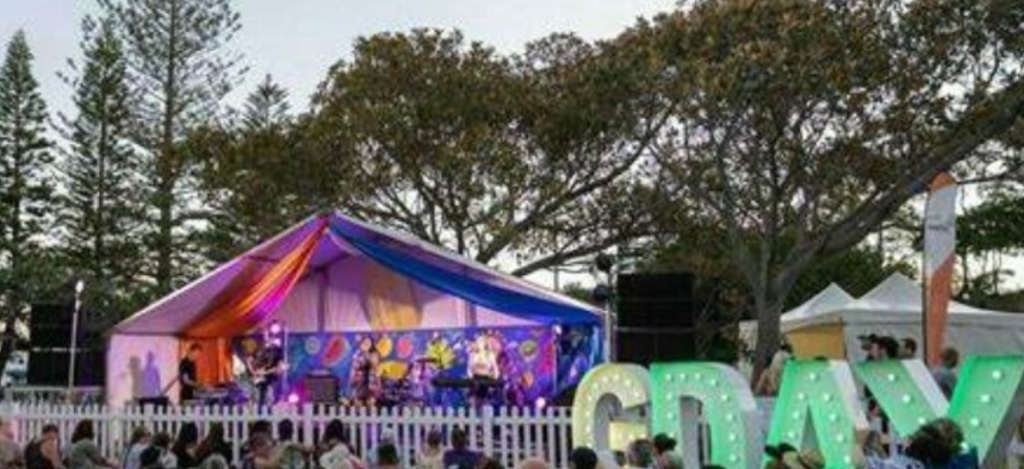
Scarborough’s Music in the Park offers a relaxed Australia Day option, with live music and free family fun in a foreshore park setting. It’s laid back and casual, with a bring-a-rug-and-folding-chairs atmosphere popular with local families.
The Belvedere at Woody Point will mark Australia Day across the long weekend, with food, drinks and entertainment spread over multiple days at its waterfront venue.
Where: The Belvedere, Woody Point When: Australia Day long weekend (Saturday 24 – Monday 26 January) Cost: Venue pricing
Brighton Roosters JRL will host a full Australia Day family fun day at their home ground, combining free entertainment with rides, games and food stalls. The program includes the sixth running of the Australia Day Mud Crab Races and concludes with a twilight fireworks display.
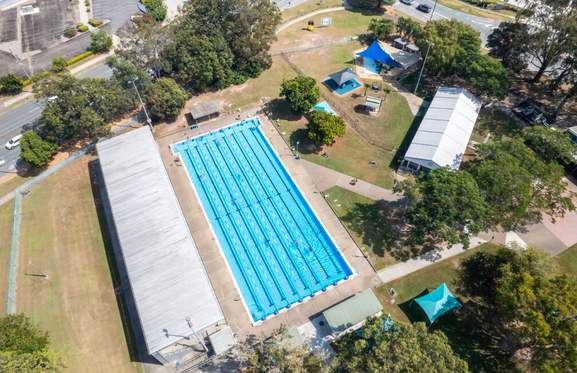
Lawnton Aquatic Centre will host an Australia Day pool party with free entry, offering a simple, close-to-home option for families to cool off and spend part of the day together.
Music in the Park returns to Bribie Island with live music in a bayside park setting, making it a popular Australia Day option for families and picnic-goers on the island. Check out the children’s activities and food trucks, with plenty of space for picnic rugs and folding chairs along the foreshore. The main stage program begins with a Welcome to Country, followed by local performers scheduled across the afternoon. Organisers note the program is subject to change and encourage attendees to come prepared with water, sunscreen and shade.
Where: Brennan Park, Bongaree, Bribie Island When: Monday 26 January, 1:00-5:00pm Cost: Free
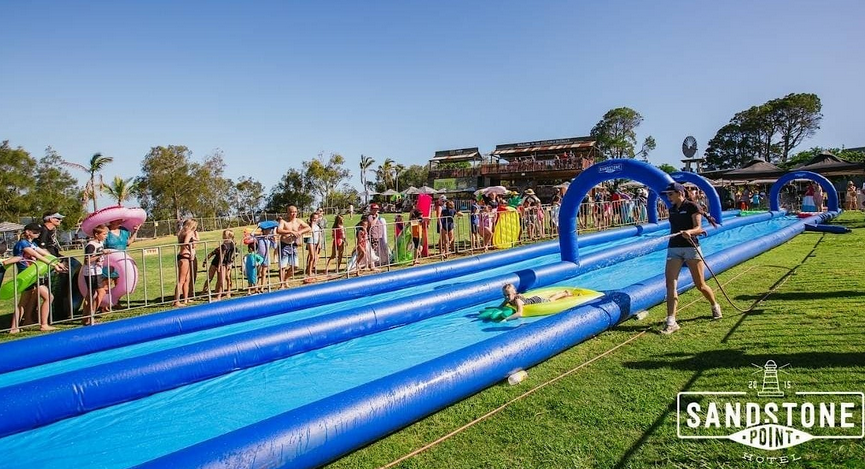
Sandstone Point Hotel’s Australia Day program includes a large slip ’n’ slide that’s bigger and better this year — more speed, more splash, across four lanes! Bring your own inflatables (must be under 1m wide) or go body-surfing from mid-morning, alongside music and family-friendly activities on the lawn.
Cactus Jack’s Redcliffe will lean into Australia Day with an all-day bar atmosphere, opening from 11am and building into live music from mid-afternoon. Local musician Luke Dickens takes the stage from 2pm, setting the tone for a relaxed but lively afternoon. It’s a walk-in, no-frills kind of event — drinks flowing, music on, and plenty of familiar faces. Expect it to be busy, noisy in a good way, and very on-brand for the venue.
Eatons Hill Hotel will mark Australia Day with a full long-weekend program running from Saturday through Monday.
The weekend begins with Triple J’s Hottest 100 in the beer garden on Saturday, followed by DJs in the nightclub later that night. Sunday features live music through the afternoon before the venue shifts back into party mode in the evening. On Australia Day itself, the focus turns to live music and classic Aussie games, with activities designed to suit both families and groups of friends.
Entry is free, with the beer garden and main bar open to all ages until 8pm. Menu and activities here.
The Peninsula Camera Club Redcliffe will be spending the day at the Caboolture Historical Village to celebrate all things Australian through photography. You’re encouraged to photograph Australia Day as you see it, capturing the many different ways the day is observed.
This month’s official outing is an open competition to allow for a wide range of Australia Day interpretations. Any Australiana images captured on 26 January 2026 will be eligible for the end-of-year competition.
Caboolture Historical Village will host a relaxed Australia Day celebration, supporting Caboolture & District Woodcrafters Inc. The event will be focused on local heritage, history and hands-on displays. The program includes food and drink stalls, live music from Blarney Stone Folk Band, kids’ activities and bush poetry, alongside working demonstrations of vintage machinery and classic cars. Visitors can explore more than 70 historic buildings across the village, with Skywind Falconry also appearing during the day for flight demonstrations and photo opportunities.
Where: 280 Beerburrum Rd, Caboolture When: Monday 26 January 2026, 9:00am – 2:00pm(Parade at 1:00pm) Cost: Adults $15 | Children 6–16 yrs $5 | 5 yrs & under free Parking: Gold coin donation
Choosing Your Australia Day, Near You
Australia Day in Moreton Bay isn’t about doing everything. It’s about finding something local that fits — a foreshore concert, a pool day, a club event or a few hours out on the bay.
This list brings together what’s happening across the region, so you can choose how to spend the day without travelling far.
Event details may change closer to January 26. Check organisers’ official pages before heading out.
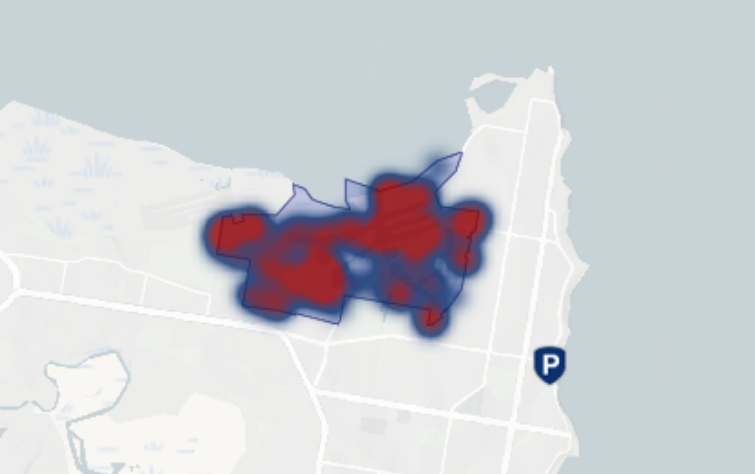
Newport recorded 193 offences between 2 January 2025 and 1 January 2026, according to the Queensland Police Service’s Online Crime Map. The figures indicate a suburb where most incidents involved theft and property-related offences.
The QPS heatmap shows strong concentrations of offences along Griffith Road, Endeavour Esplanade, and Condor Street near Newport Park, extending through residential areas near Nathan Road and Coolum Parade. These hotspots align with Newport’s main thoroughfares and popular recreational zones, where higher foot traffic and activity levels naturally occur.
Photo credit: QPS Online Crime Map
The most common offences were other theft (excluding unlawful entry), traffic and related offences, and unlawful entry. Together, these categories dominated the year’s incident reports. Other recurring offences included unlawful use of a motor vehicle, drug offences, and property damage.
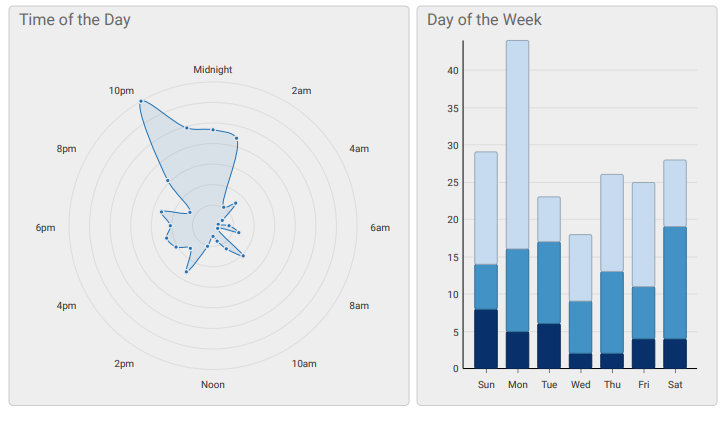
Time-of-day data shows the 10pm to 6am window recorded the highest number of offences at 94 incidents, followed by 2pm to 10pm with 68 reports. The quietest time was 6am to 2pm, with just 31 offences. This pattern indicates that Newport experiences most of its crime during evening and overnight hours.
By day of the week, Sunday and Monday were the busiest for reported incidents, while Tuesday and Wednesday saw noticeably fewer. The weekend spike may reflect increased activity around Newport’s parks and waterfront areas.
Photo credit: QPS Online Crime Map
The date-range chart indicates the highest monthly totals were recorded in July with 35 offences, followed by October with 24, and August and September both recording 21 incidents. The quietest months were April with just 8 offences, June with 11, and May with 14. This mid-year surge is notable, though the reasons behind it remain unclear without further analysis.
Most incidents recorded were thefts, property offences, or vehicle-related matters typical of residential bayside suburbs. Newport’s proximity to recreational areas and its mix of permanent residents and visitors may contribute to its crime profile.
Overall, the data presents Newport as a suburb where practical precautions, such as securing vehicles, locking homes, and being mindful of personal belongings, remain important. With 193 offences across the year, residents should stay vigilant, particularly during evening and overnight hours when most incidents occur.
Spinnaker Park has become a landmark destination for families in Newport, celebrated for its inclusive design, imaginative play spaces and waterfront setting. Designed to ensure children of all abilities can play side by side, the park has helped cement Newport’s reputation as a family-friendly community.
What continues to set Spinnaker Park apart, however, is not just its design credentials, but the way it has evolved into a much-loved local haunt — a place families return to again and again.
Why Spinnaker Park Continues to Be a Favourite Haunt in Newport
In 2021, Spinnaker Park was voted Australia’s favourite playground — a title that reflects its broad appeal and lasting popularity. Years on, the park remains one of Newport’s most visited public spaces, drawing not only local families but visitors from across Moreton Bay and beyond.
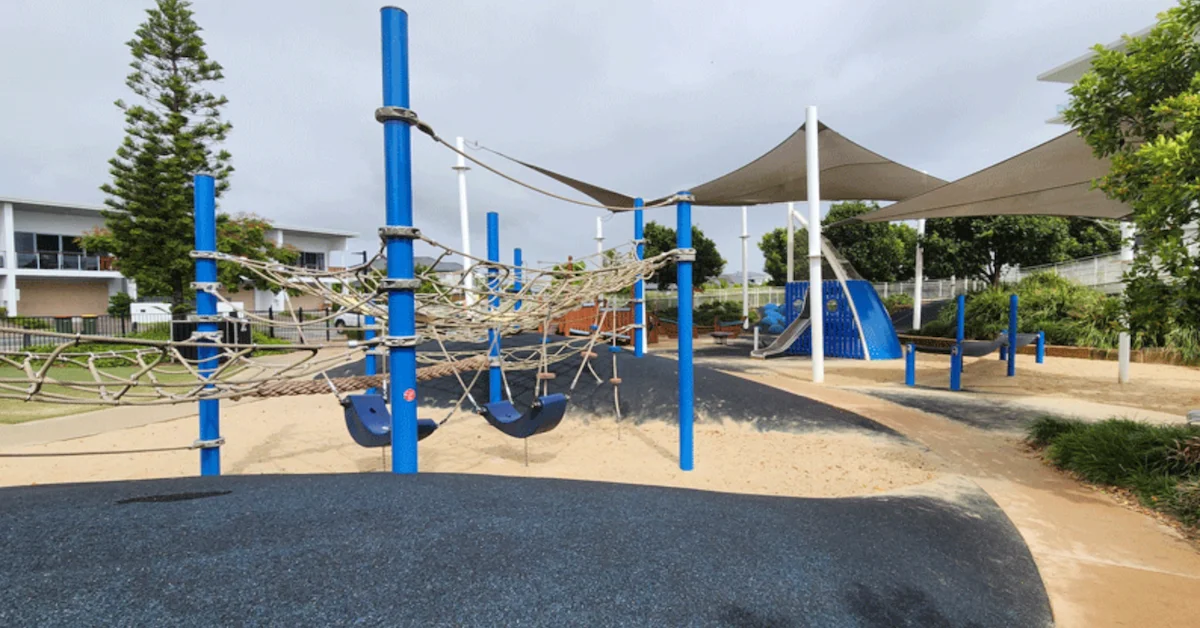
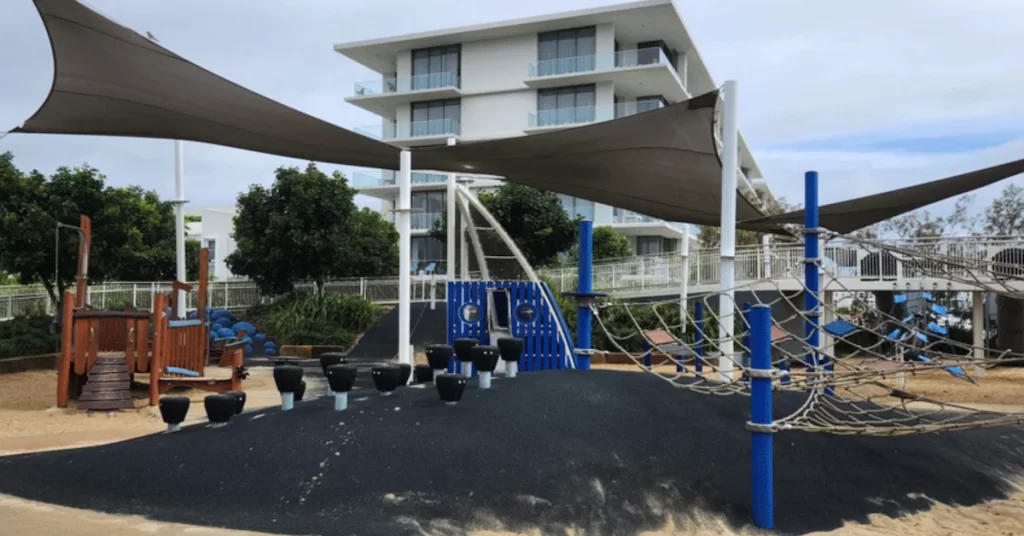
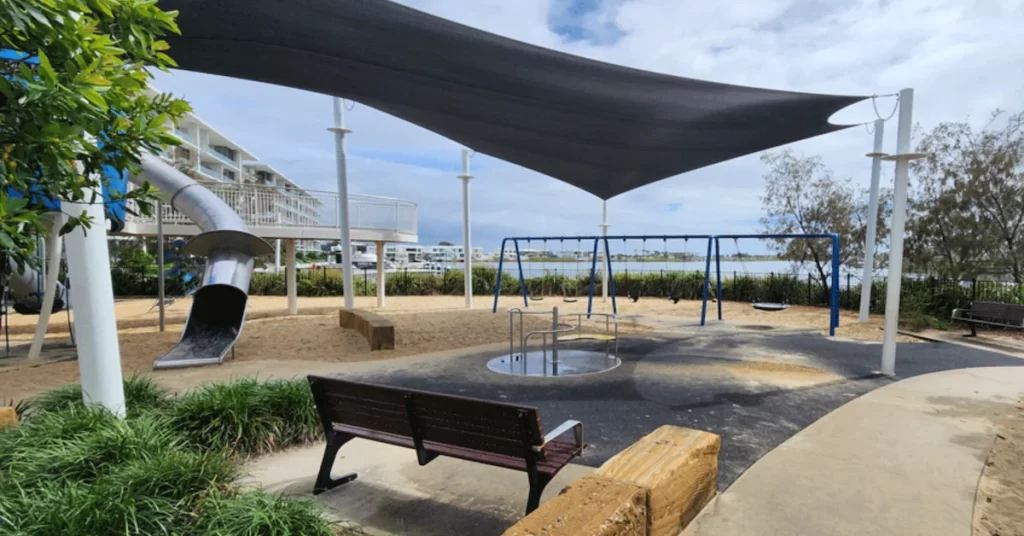
Located at 39 Lakeview Promenade, Spinnaker Park is a purpose-built community space created to cater to children of different ages and abilities. The playground features a climbing tower, accessible swings, spinners, and a fully fenced area designed to ensure safety and comfort. Soft artificial grass, rubber matting, and sand make play safer, while large shade sails provide protection from the Queensland sun.
The park includes an interactive ship, water play zone with zero-depth splash areas, and an accessible ramp leading to a lookout with sweeping views of the Newport Canals. The playground was designed in collaboration with the Touched By Olivia Foundation, ensuring features are accessible for children with physical disabilities and spectrum disorders. There is also an area for launching kayaks and paddle boards, which opens up recreational opportunities for the whole community.
Photo Credit: City of Moreton Bay
Facilities at the park include picnic and barbecue areas, water fountains, toilets (including accessible facilities), parking, and landscaped gardens. Public art installations and night-time water feature displays add another layer of attraction, making Spinnaker Park a popular gathering point throughout the day and into the evening.
More Than a Playground
While inclusive design remains central to Spinnaker Park’s identity, its ongoing popularity is also driven by the sheer variety of experiences it offers. The nautical-themed playground encourages imaginative play, with a sail-inspired climbing tower, slides, nets and balance features that challenge children of different ages.
A zero-depth water play area adds another layer of appeal, especially during warmer months, allowing children to cool off while parents relax nearby.
Photo Credit: City of Moreton Bay
The park is set within the broader Stockland Newport community, which is still expanding. Plans for the area include more homes, a town centre, waterside dining, and additional green spaces. Spinnaker Park’s success is a sign of Newport’s commitment to building inclusive, active, and vibrant neighbourhoods for residents now and in the future.
A Waterfront Setting Families Love
Set against the calm waters of Newport’s lake, Spinnaker Park offers more than just play equipment. Shaded seating, barbecue facilities and open lawns invite families to linger, picnic and socialise.
Many locals describe the park as a regular meeting place — somewhere to catch up with friends, celebrate birthdays or simply enjoy time outdoors. This sense of community connection has helped the park remain a favourite long after its initial opening.