




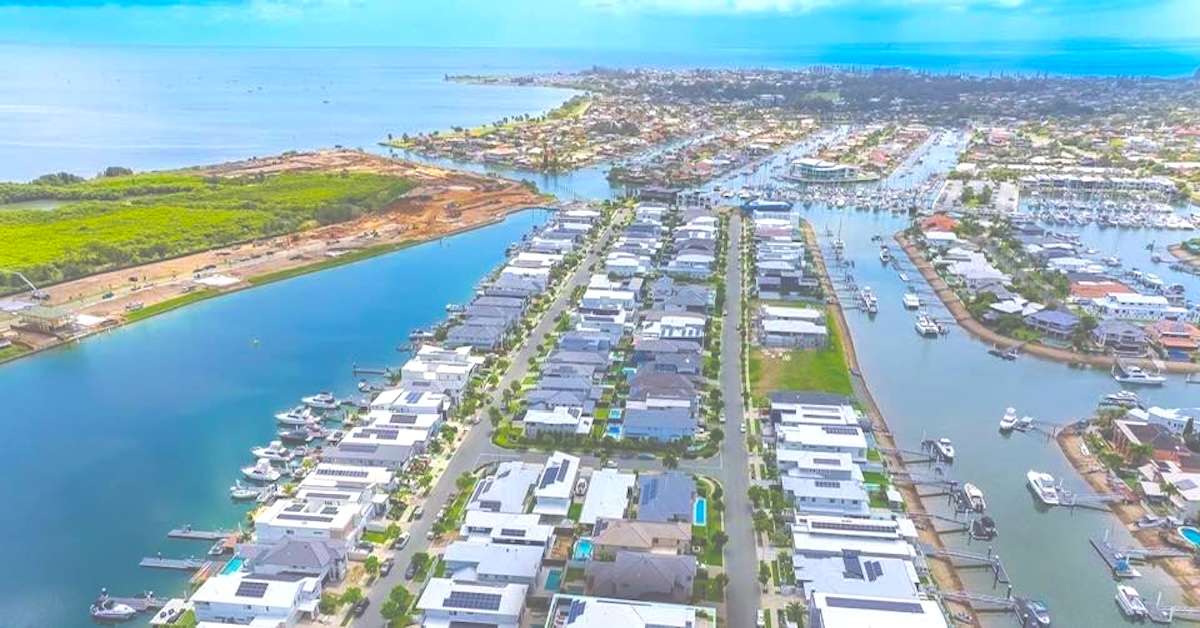
The tide comes into Newport’s canals, bringing tiny particles of sediment from Deception Bay. Hours later, the water flows back out, but some of those particles never make the return journey. It is a small but persistent puzzle beneath Newport’s waterways, where years of engineering research have examined how sediment moves, where it settles, and why the tides do not simply carry it all away.
Read: Major Dredging Project Targets Newport Waterways
The connection runs through a dredged entrance channel approximately 2.4 kilometres long, linking Newport’s residential canals and marina to Deception Bay and the wider Moreton Bay. Water moves through the channel with the tides, bringing suspended particles along for the journey.
Not all of those particles remain in Newport. Some are carried back out, while others settle when local currents weaken. Over time, the difference between what arrives, what settles and what leaves can produce a gradual build-up on the canal floor.
Why the Outgoing Tide Doesn’t Take Everything Back
Sediment does not always travel along the seabed. Very fine particles can remain suspended in moving water, particularly when waves and currents stir up material that has previously settled.
Deception Bay contains sediment that may have travelled from surrounding waterways or other parts of the coastal environment. Waves and tidal currents can lift some of that material into the water, allowing it to move towards Newport’s entrance channel.
As the tide rises, suspended particles can travel into the canal network. Their movement depends on several factors, including current speed, particle size and the shape of individual waterways.
A glass of muddy water offers a simple comparison. Stir the contents and fine particles spread throughout the water. Stop stirring and some begin to sink, although the smallest particles may take longer to settle.
Newport’s waterways are more complicated because currents continue to change. Around the turn of the tide, however, slower water movement can allow some suspended sediment to settle.
When the current strengthens again, particles on the bottom may be stirred up and carried elsewhere. Others remain undisturbed.
The outgoing tide therefore does not automatically reverse everything that happened during the incoming tide. Water can leave without removing all the sediment deposited earlier.
Deception Bay’s Dominant Role in Sediment Build-Up
Newport’s sediment origins were examined in engineering investigations summarised in the Newport Waterways Long Term Maintenance Plan, prepared by BMT JFA Consultants in August 2016.
The plan cites an earlier investigation identified as KBR 2013a, which attributed approximately 95 per cent of settled sediment in the canal estate to material entering from Deception Bay through natural tidal exchange.
The remaining five per cent was attributed to freshwater-related sources, including stormwater outlets and Walkers Creek.
Those proportions are historical engineering estimates, not measurements of the sediment entering Newport in 2026. The original KBR report has not been independently examined for this article, although its findings are explicitly referenced in the published maintenance plan.
Deception Bay’s role also needs a distinction. Identifying the bay as the immediate source of incoming sediment does not establish where every particle originally formed.
Some material may have reached the bay through rivers, creeks, coastal erosion or earlier sediment movement before being stirred up and carried into Newport. The available Newport maintenance records do not establish how much each of those more distant sources contributed.
Local rainfall can also influence sediment movement. Stormwater may carry soil and fine particles into waterways, while flows through Walkers Creek provide another route for material to enter the canal system.
The 2016 plan identified variations in rainfall, suspended sediment concentrations and tidal velocities among the factors affecting accumulation. It also cautioned that future sedimentation rates could not be forecast accurately because the processes were complex and variable.
Why Some Newport Canals Accumulate More Sediment
Sediment does not accumulate evenly across Newport’s waterways.
The maintenance plan adopted historical average annual accumulation estimates of 1,880 cubic metres for the Northern Marina Basin, 790 cubic metres for Kingfisher Canal and 430 cubic metres for Curlew Canal.
The figures were developed for long-term planning using earlier assessment periods, including 2004–2009 and 2009–2015. They are not current annual measurements, nor do they mean that the same amount settles in each location every year.
Engineers investigate changes beneath the surface using hydrographic surveys, which map underwater depths. Comparing surveys taken at different times can reveal where the canal bed has risen or fallen.
The City of Moreton Bay publishes Newport hydrographic survey documents from 2020, providing an example of the underwater measurements used to understand the canal network.
Depth measurements can show where the floor has changed, but they cannot alone reveal the original source of individual sediment particles.
The explanation for Newport’s accumulating mud ultimately comes down to the difference between moving water and moving sediment. Tides carry water into and out of the canals, but the particles travelling with it can settle, lift again or take a different route.
Read: New Research Highlights Dolphins Living Beyond Newport’s Canals
For Newport, the canal floor is shaped by that continuing exchange with Deception Bay, one tide at a time.
Published 28-Oct-2026